
Your AI-built MVP has customers. What comes next?
How to turn a working product into technology you can understand, operate and safely extend.
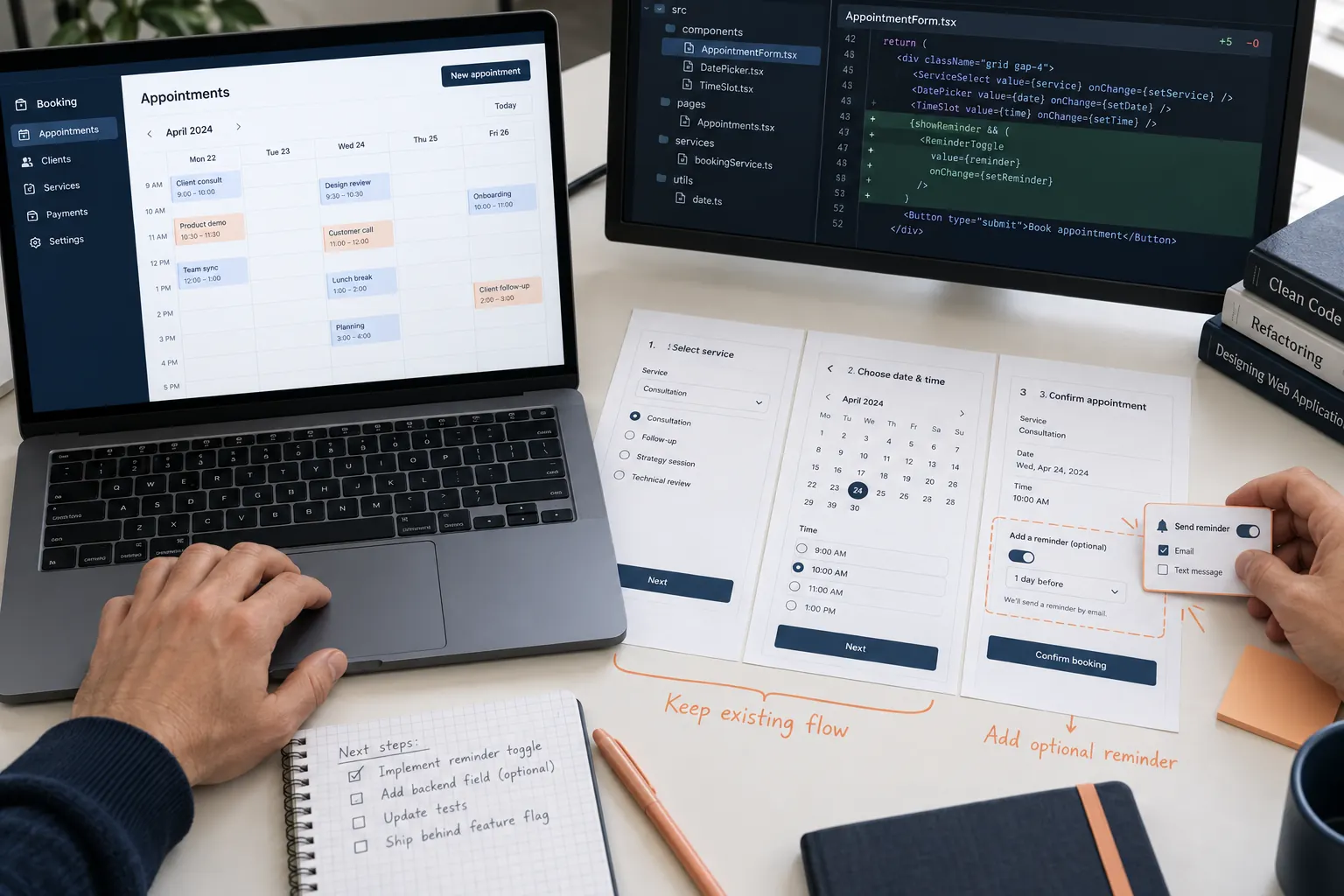
Start with the customer journeys that already matter. Establish ownership, inspect the critical paths and improve the parts that limit the next stage.
Start with what customers depend on
A product that people return to has something worth preserving. If AI helped you build it, the next decision is rarely whether every generated line should survive. The useful question is whether you can explain how the product delivers its value, where it could fail and how you would change it without losing the behavior customers rely on.
Begin with three real journeys. Choose the action that first gives a customer value, the action they repeat most often and the action whose failure would be hardest to repair. Follow each from the screen through the application and into its stored records or external services. A working interface can conceal a missing permission check, a fragile background job or a result that only appears to have been saved.
This exercise should produce a short map and a list of unanswered questions. Keep it concrete. “A document upload creates a job, which extracts text and stores a searchable result” is more useful than a diagram containing every library. The map gives an engineer somewhere to begin and gives the founder a way to follow the reasoning.
Make the system reproducible
Before accelerating development, establish whether someone other than the original builder can run the application and release a small change. Locate the source code, configuration, deployment instructions and accounts that operate the service. Record which settings belong in each environment. Secrets should be handled through the platform’s appropriate secret storage rather than copied into source files or shared notes.
Try a fresh setup using the written instructions. Missing steps are evidence about operational dependence, even when the product appears healthy. A system that runs only on one person’s laptop is difficult to repair under pressure. The objective is a repeatable path from a known version of the code to a working application, with a record of what changed.
AI can help explain unfamiliar code and draft that documentation. Its explanations still need comparison with actual behavior. GitHub’s responsible-use guidance explicitly calls for reviewing and validating generated outputs. A plausible description of a function is a starting hypothesis; a request traced through the running application is evidence.
Review boundaries before tidying code
Some defects deserve attention before code organization. Check that one customer cannot access another customer’s records, that privileged actions are checked on the server and that important writes remain correct when requests are repeated. Examine what happens when an external service responds late or fails entirely. These questions address consequences customers experience, rather than how polished the repository looks.
Consider a hypothetical document product. The interface disables its submit button after a click, but a browser retry sends the request twice. If each request starts an independent processing job, the customer may receive duplicate results. The fix belongs at the operation’s boundary: define how the system recognizes an already accepted request and returns its existing outcome. A prettier button would leave the underlying behavior unchanged.
Database rules can reinforce these boundaries. PostgreSQL supports constraints such as uniqueness and foreign keys, which protect particular relationships in stored data. Their usefulness depends on expressing the right rule. An engineer should connect each proposed constraint to a real product invariant, such as one active membership for a given user and workspace.
Build confidence around a small change
Choose one valuable improvement and record the behavior it must preserve. Add focused checks around that behavior before changing its implementation. Include an ordinary successful request, a meaningful failure and a relevant boundary case. A long collection of tests that simply repeats the code’s assumptions can still miss the customer’s actual problem.
Release with enough visibility to see whether the intended journey still works. Observe completions and failures, not just whether the server is running. For an asynchronous feature, accepting a job and finishing a job are different events. A customer who waits indefinitely has experienced a failure even if the initial request returned successfully.
Keep the change small enough to explain and recover from. Afterward, capture what the team learned about the system. Over several improvements, this creates a dependable picture of the product and makes later decisions less speculative. It also reveals which areas can remain untouched.
Use evidence to choose the next investment
Ask the team to separate immediate risks, demonstrated constraints and longer-term improvements. Immediate risks concern harmful behavior that can already occur. Demonstrated constraints have an observed connection to current or expected demand. Longer-term improvements may be sensible, but should have a reason and a point at which they become worth doing.
A rewrite may eventually be justified by a specific limitation. It should not be the automatic consequence of discovering generated code. Equally, the fact that customers use the product does not prove its foundations are sound. Preserve useful behavior while investigating the important unknowns. The next stage begins when the team can make a considered change, observe its effects and recover if its assumptions were wrong.
Frequently asked questions
Does an AI-built product need to be rewritten before it can scale?
Not automatically. First trace the customer journeys, check permissions and repeated requests, and test a small change. A rewrite needs a specific limitation that cannot reasonably be addressed in the existing system.
What should I check first in an AI-built MVP?
Start with the actions customers rely on. Follow them through the application, database and external services. Check that another engineer can run and release the product, and that customer records and important writes are protected.
Can AI help maintain the product after launch?
AI can help explain code and draft documentation, but its output still needs review against the running application. Use focused tests and observed customer journeys to check that an explanation or change is correct.